

Basic Pâte à Choux Recipe
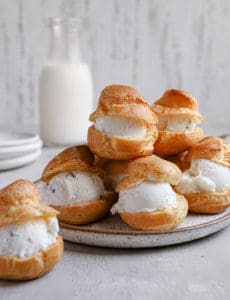
I’m sharing all my tips for making light as air pâte à choux. This delicate pastry makes airy pastry perfect for filling with sweet and savory stuffings. Learn everything you need to know about choux pastry from how to make, pipe, store, and fix some of the most common issues.
The Background
If you are not familiar with choux pastry, it’s a light and airy dough used to make desserts ranging from eclairs to churros and more. This unique dough is twice-baked, first on the stove, to create a silky smooth finish. Then it bakes to golden perfection in the oven.
Made with water, eggs, flour, and butter the pastry has a high moisture content which causes the pastry to rise and leave space for delicious fillings to be stuffed with pastry cream or other fun fillings. Once you’ve mastered making choux pastry, the delicious treats you can make are endless including:
- Eclairs: Pastry cream is piped into long logs and then filled with pastry cream and topped with chocolate.
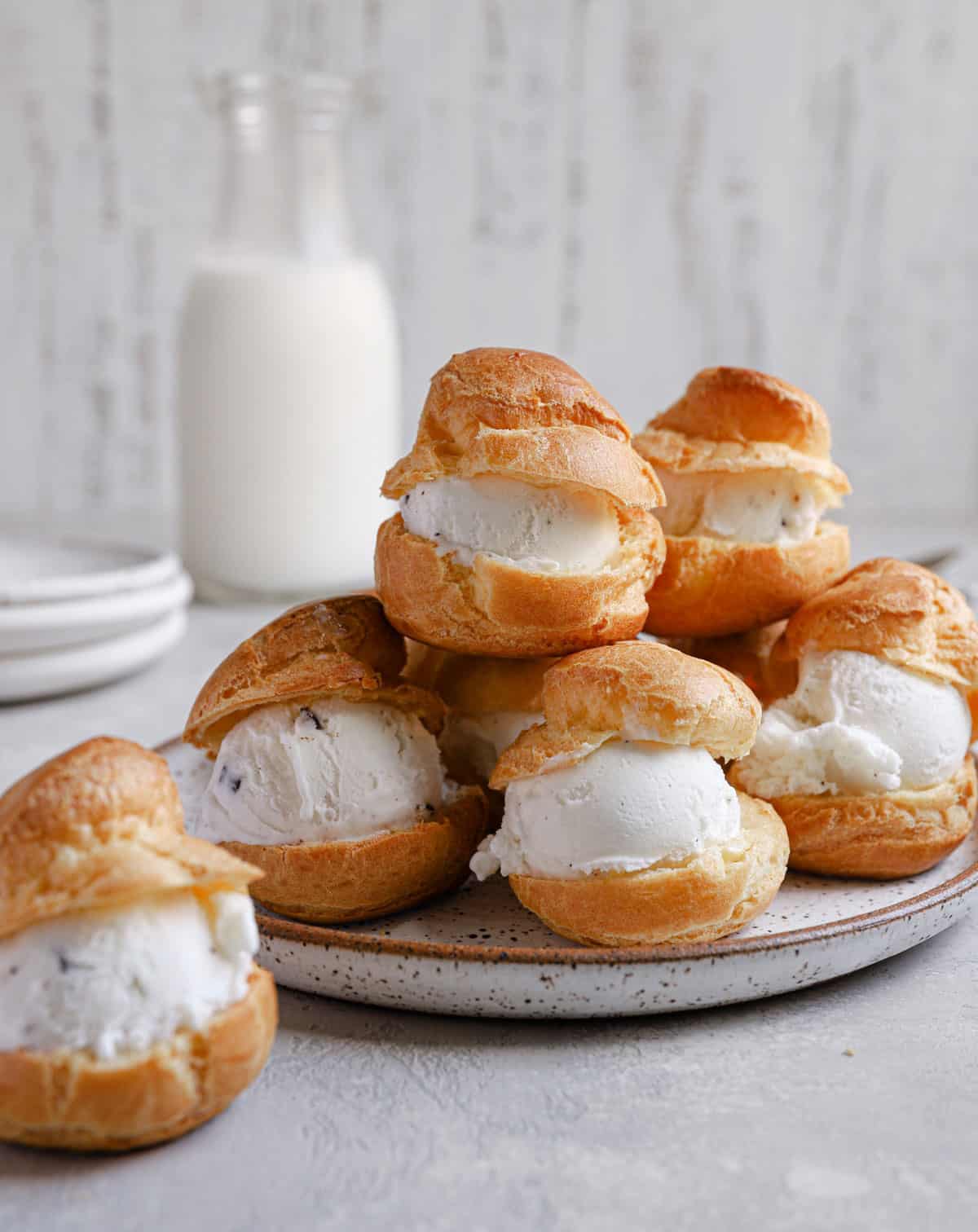
- Profiteroles: Also known as cream puffs, profiteroles are filled with pastry cream or ice cream. They often come served with a silky chocolate topping.
- Croquembouches: A cone-shaped tower made from choux pastry puffs baked and dipped in caramel binding the tower together.
- Gougeres: A savory appetizer made with choux pastry.
- Beignets: The dough is fried instead of baked into a type of fritter.
- Churros: Piped from a star-shaped nozzle and fried into a crispy treat.
Ingredients
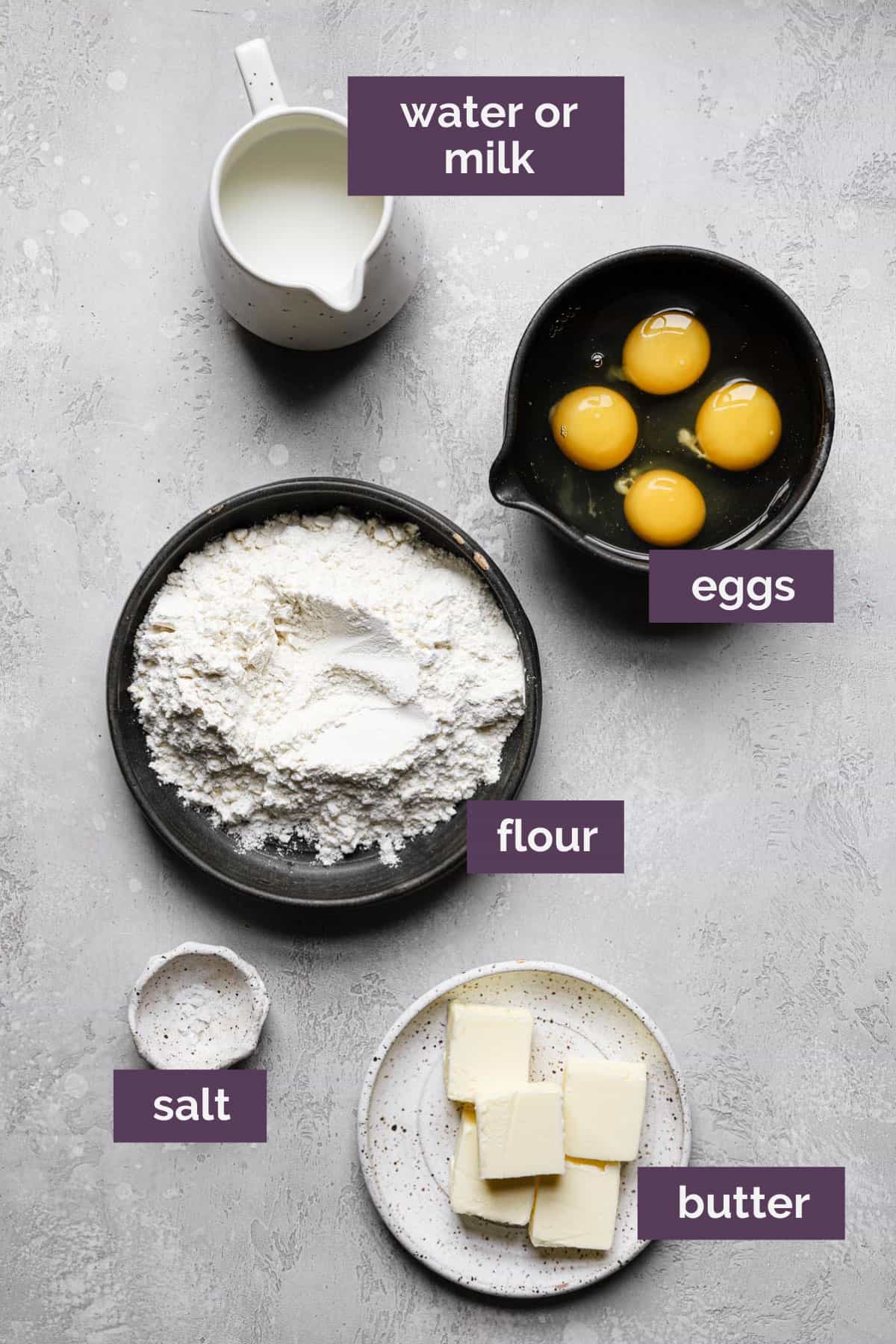
The beautiful thing about this dough is that it uses just a handful of pantry staple ingredients that you probably already have on hand.
- Milk: You can also use water or a combination of both water and milk. Depending on the final pastry you are making with the dough, one or the other may be called for in the recipe.
- Butter: During the baking process, this allows the pastry to rise.
- Salt: Gives a little flavor to the choux.
- Flour: Gives structure to the pastry.
- Eggs: Helps give the pastry structure and makes a crisp outer shell.
Step-by-Step Directions
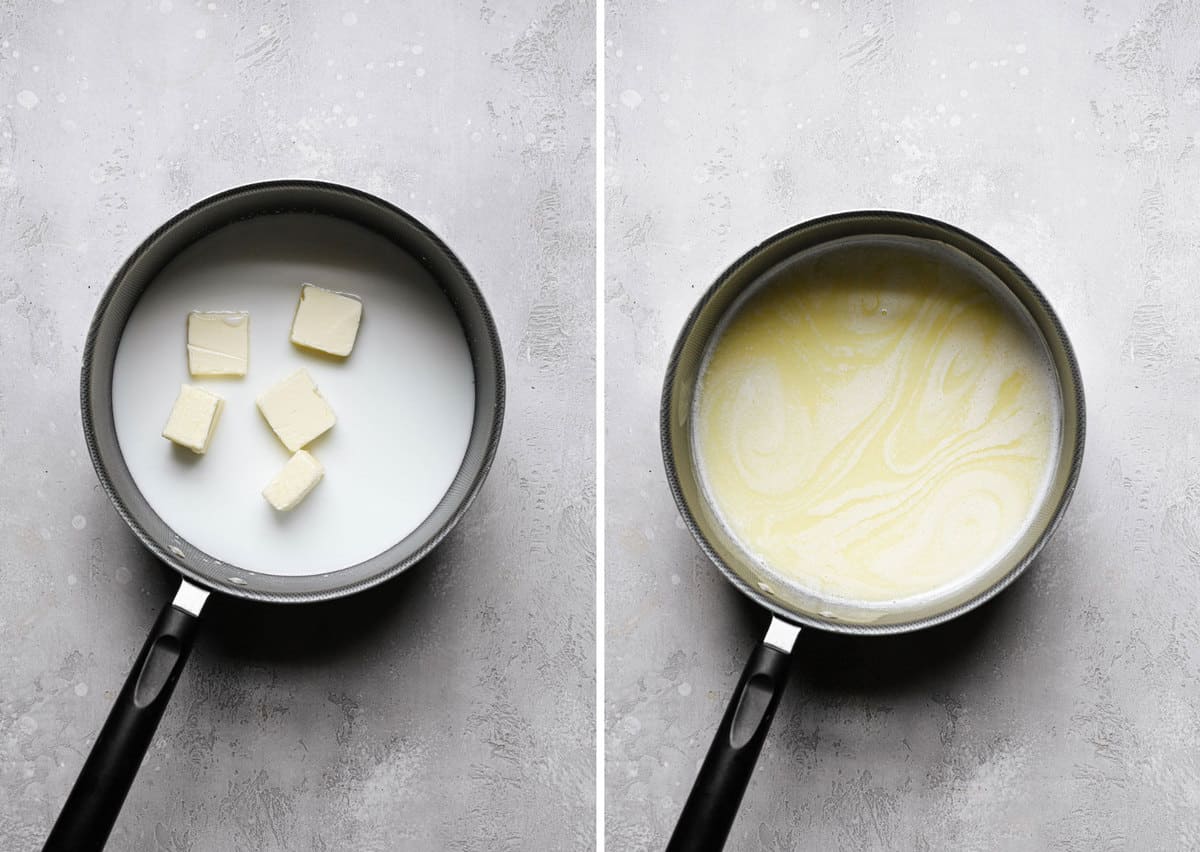
- Boil milk, butter, and salt: Place the water or milk, butter, and salt in a medium saucepan. Place over high heat and bring to a full rolling boil.
- Add the flour: Remove from the heat and add the flour all at once. Using a wooden spoon or a stiff silicone spatula, stir until the flour is thoroughly mixed in and no clumps remain, pressing and smashing the dough against the sides of the pan.
- Stir the dough together: Return the pot to medium-high heat and cook, stirring frequently until the dough comes together in one mass and there is a dry film on the bottom and sides of the pan.
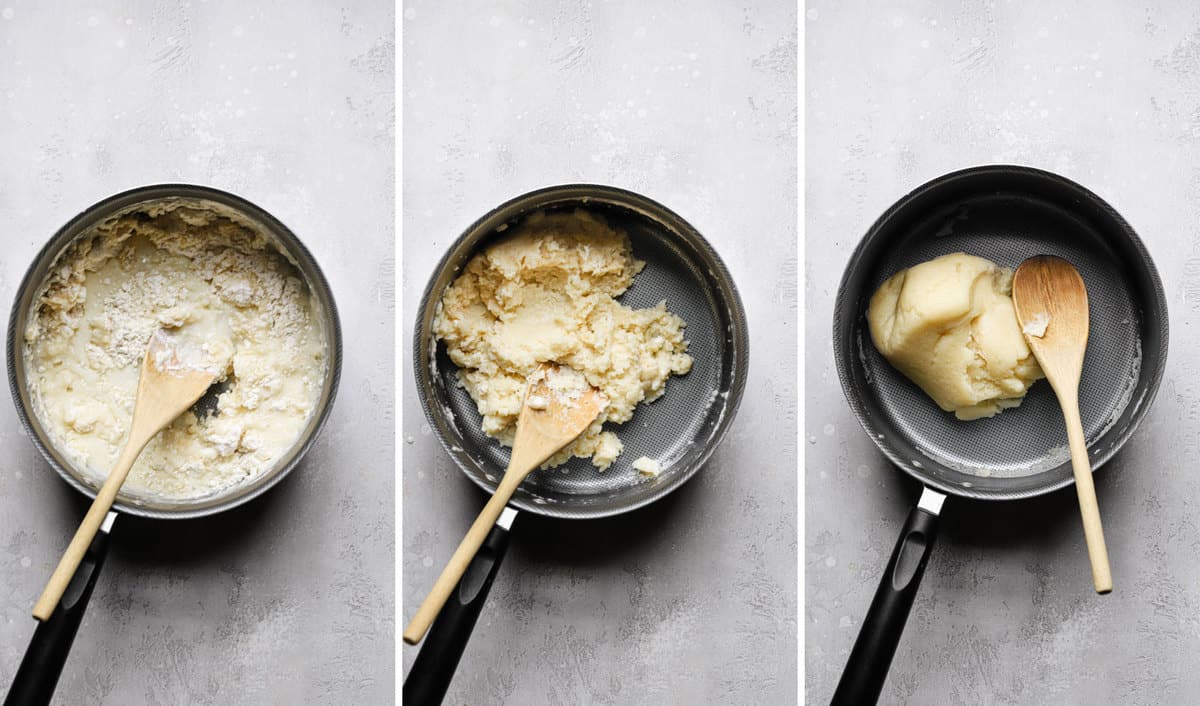
- Check the temperature: If you have an instant-read thermometer the temperature of the dough should register at 175°F.
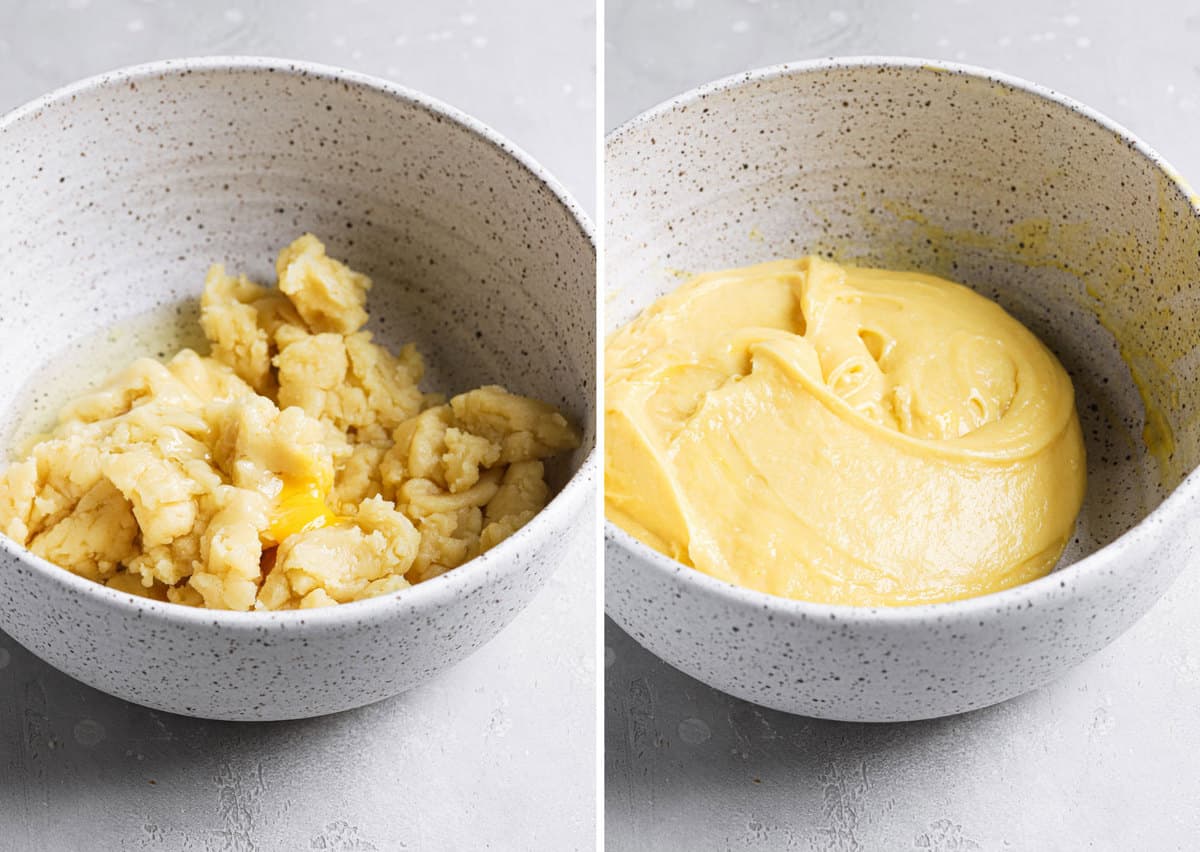
- Beat in a mixer: Transfer the dough to a mixing bowl and beat on medium speed for about 2 minutes to cool the dough down. Check the temperature again, it should read about 145°F.
- Mix in eggs: Add the eggs one at a time, ensuring each one is fully incorporated before adding the next. Once all of the eggs have been added scrape down the bottom and sides of the bowl and mix again to ensure everything is fully incorporated for an additional 5 to 10 seconds.
Piping the Dough
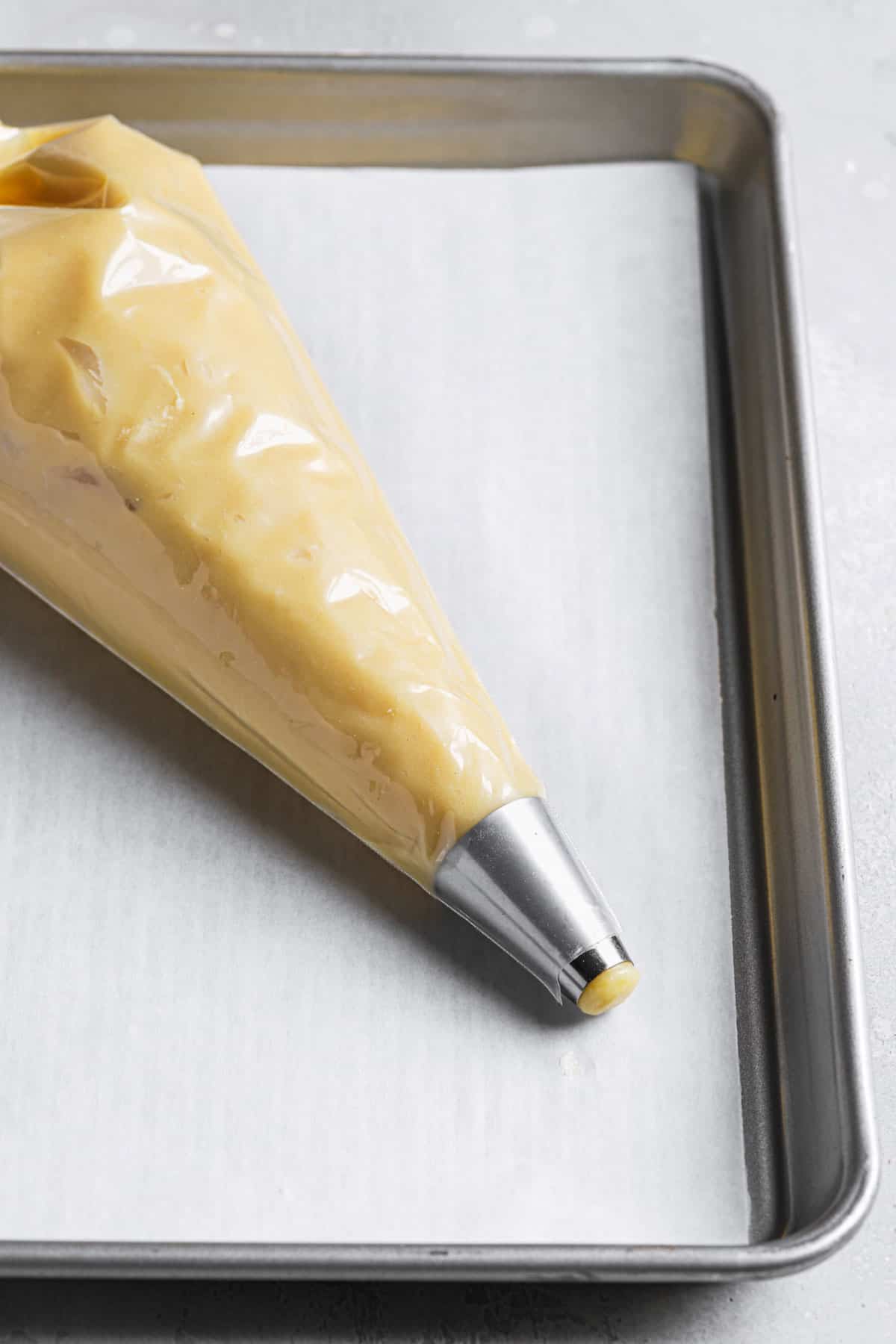
Once you’ve made the dough, you will then need to determine what shape pastry you plan to make. I’ll give you directions for piping some of the most common choux pastry shapes.
-
Round (for puffs)– Use a round 1/2-inch piping tip. Make sure the tip always touches the dough to prevent ripples. Hold the bag upright as you pipe the dough to ensure the pastry will rise upwards.
-
Elongated (for eclairs)– Use a round or French star tip pipe the dough out at a 45° angle and keep consistent pressure while you pipe.
After piping the rounds and eclairs, be sure to dip your finger in water and flatten any points that might have been made with the pastry tip to prevent spots from burning.
Baking
After piping your pastry onto parchment paper, you are ready to bake these beauties!
Save This Recipe
Depending on the different pastry you plan to make your baking instructions will change.
Filling Options
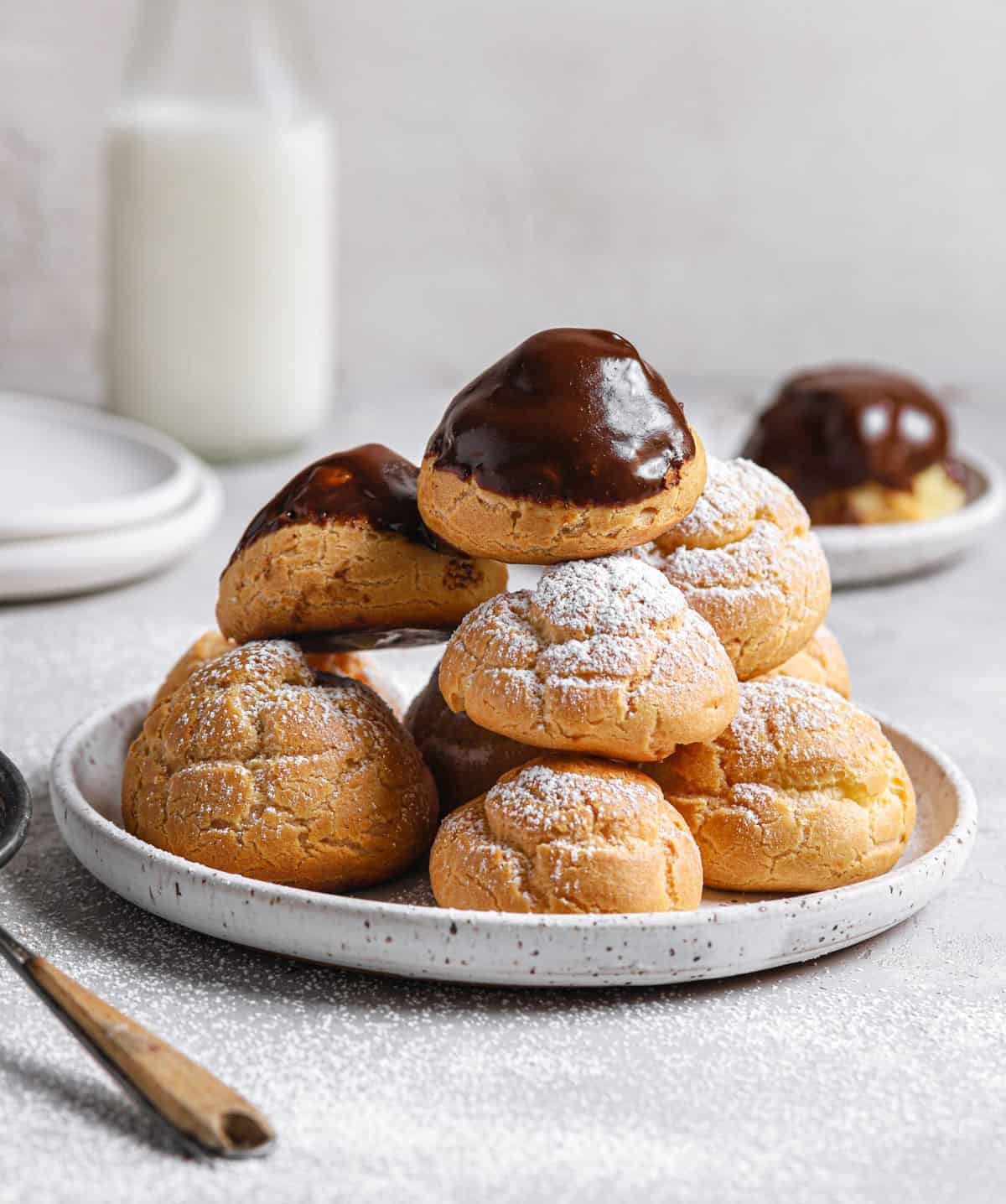
Now, this is where you can really get creative with choux pastry. Since the dough is rather bland in flavor, you can really dress it up by stuffing it with many different fillings. Some of my favorite ways to fill baked pâte à choux include:
- Pastry cream
- Lemon curd
- Ice cream
- Homemade whipped cream
FAQ and Troubleshooting
Some of the most common issues surrounding choux pastry include runny dough and collapsed pastries. Let’s talk a little bit about why these issues occur, how you can prevent them, and ways to fix the issue if they happen.
Collapsed Pastry
There are two main reasons your pastry will collapse. The first is that the oven was opened before the choux cooked through. This happens when you open the oven to check on them before the cooking time is complete. I would suggest keeping the door closed the first 20 minutes of baking before peeking for a doneness check.
By opening the oven you allow the steam to escape preventing the exterior of the pastry from crisping up.
Choux pastry also collapses when you do not prick the baked pastry shells to vent the hot air from inside. If un-vented, the hot air adds moisture inside the pastry and causes it to collapse while cooling.
Making in Advance
- Store unfilled baked pastry shells in an airtight container for up to 2 days. Reheat them in the oven to crisp up and fill.
- Freeze baked pastry shells in an airtight container for up to 3 months, thaw, and bake to crisp up before filling.
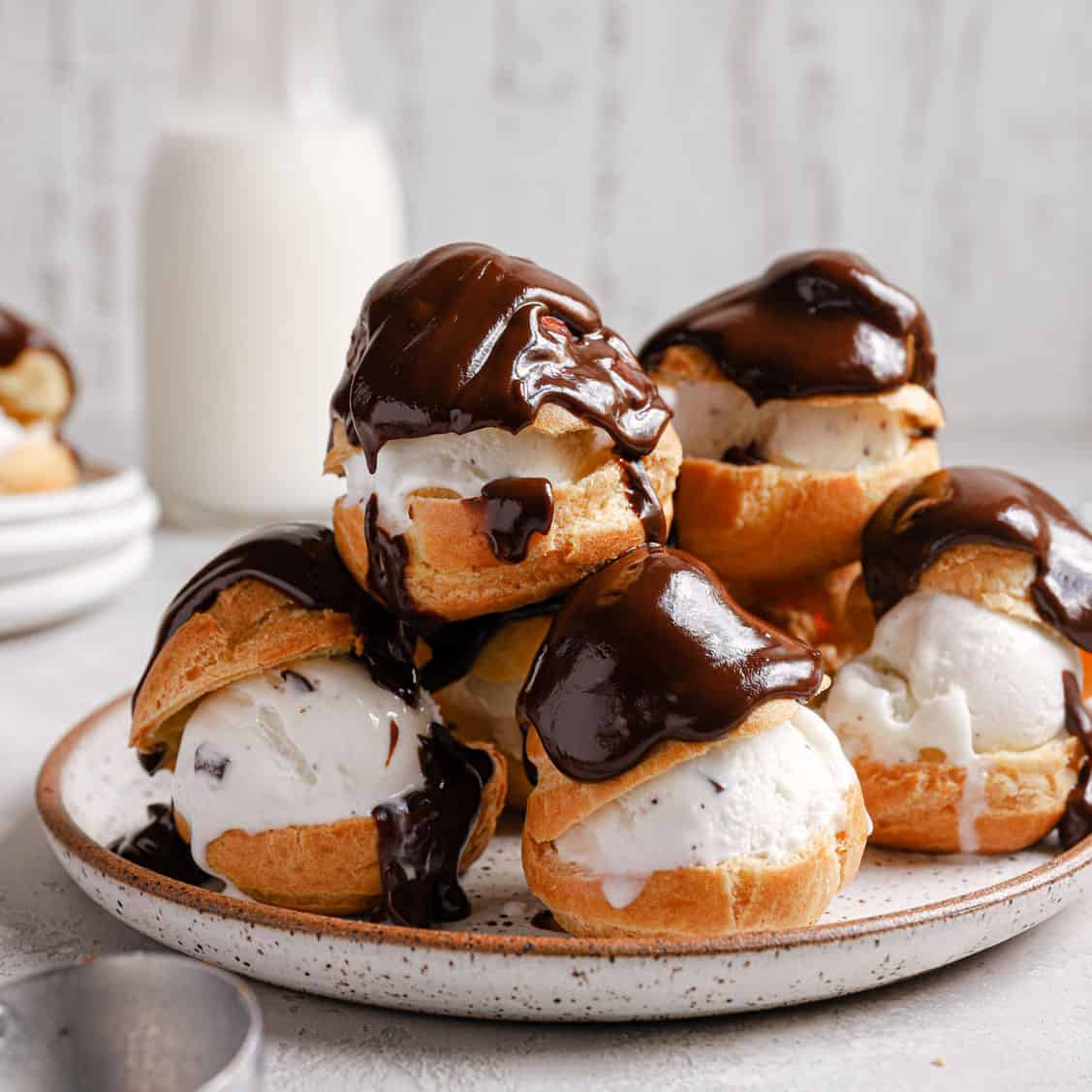
What to Make with Pâte à Choux
Take on the art of making choux pastry at home with this in-depth guide. From making the dough to troubleshooting the biggest issues, this guide has you covered for all your pâte à choux needs!
Watch the Recipe Video Below:
If you make this recipe and love it, remember to stop back and give it a 5-star rating - it helps others find the recipe! ❤️️
Pate a Choux Recipe
Ingredients
- 1 cup (240 ml) milk or water, or combination
- 6 tablespoons (85 g) unsalted butter, cut into ½-inch cubes
- ½ teaspoon (0.5 teaspoon) kosher salt
- 1 cup (120 g) all-purpose flour, sifted
- 4 eggs
Instructions
- Place the water or milk, butter, and salt in a medium saucepan. Place over high heat and bring to a full rolling boil.
- Remove from the heat and add the flour all at once. Using a wooden spoon or stiff silicone spatula and stir until the flour is thoroughly mixed in and no lumps remain, pressing and smashing the dough against the sides of the pan.
- Return the pot to medium-high heat and cook, stirring frequently, until the dough comes together into one mass and there is a dry film on the bottom and sides of the pan. If you have an instant-read thermometer, it should register 175 degrees F.
- Transfer the dough to a mixing bowl and beat on medium speed for about 2 minutes to cool the dough down. It should register 145 degrees on an instant-read thermometer.
- Add the eggs one at a time, ensuring each one is fully incorporated before adding the next. Once all of the eggs have been added, scrape down the bottom and sides of the bowl and mix again to ensure everything is fully incorporated, an additional 5 to 10 seconds.
- Use immediately or keep at room temperature for up to 2 hours in a piping bag or with a piece of plastic wrap pressed against the surface.
Notes
- Make the Dough By Hand: You do not need a mixer to make this dough; I often make it by hand. Cool it down by stirring it frequently with a spoon or spatula, then beat in each egg one at a time by hand.
Did you make this recipe?
Leave a review below, then snap a picture and tag @thebrowneyedbaker on Instagram so I can see it!
Photography by Dee Frances



The explanation of the “double-baking” process for pâte à choux really clarified why it achieves that signature crisp exterior and hollow interior. I’ve always been a bit intimidated by choux pastry, and Michelle’s breakdown of the key steps, like properly incorporating the eggs and the importance of the initial dry-out phase on the stove, makes it seem much more approachable. It reminds me a bit of how certain alchemical processes in games require precise timing and ingredient ratios to achieve the desired outcome. I wrote about a similar approach to breaking down complex crafting mechanics on KCD2Quest and found that clear, step-by-step guides are invaluable for beginners. I’m definitely going to try this recipe this weekend!
The troubleshooting notes are especially useful—the explanation of how opening the oven too early releases steam makes the cause of collapsed choux much easier to understand. I also appreciated the precise piping guidance, including keeping the tip against the dough for round puffs and flattening pointed tops with a damp finger to prevent burning. On a broader digital-content note, images of polished baking results can sometimes be difficult to assess online; https://aiimagedetector.art offers free checks for signs that an image may be AI-generated, including batch uploads when needed.
The explanation of the “double-baking” process for pâte à choux really clarified why it achieves that signature crisp exterior and hollow interior. I’ve always been a bit intimidated by choux pastry, so the detailed troubleshooting section is a lifesaver. It’s great to know that common mistakes like a dough that’s too wet or dry can be fixed. I’m hoping to try making cream puffs for the first time, and this guide feels like the perfect starting point. I wrote a similar guide for navigating complex maps in games, and found that breaking down the process into manageable steps is key to success, much like you’ve done here with your Subnautica 2 Map. This recipe seems to follow that same principle perfectly.
Merci pour ces astuces précieuses ! La pâte à choux a toujours été un défi pour moi, mais vos conseils sur la cuisson sont très clairs. Hâte d’essayer pour des éclairs parfaits !anime image upscaler
If you need to fix text in a screenshot or image without rebuilding the design, PhotextAI may help. It detects text automatically, lets you replace and restyle it, and exports the result at the original image dimensions.
https://photextai.com/
The detail about the “dough being twice-baked” really clarifies the magic behind pâte à choux. I always wondered how it got so puffed up and hollow. My first attempt at cream puffs was a bit of a disaster – they came out dense and greasy, probably because I didn’t let them cook long enough or maybe I opened the oven too soon, like you cautioned against! It’s reassuring to see a recipe that addresses common problems, making it feel more approachable. I’m excited to try this method and finally achieve those light, airy results. I previously wrote about some basic baking troubleshooting on ShrugMoji and the principles are often similar, even with a specialized dough like this. Thanks for the clear breakdown!
Merci pour ces astuces précieuses ! La pâte à choux maison est un vrai délice, et vos conseils pour des éclairs légers sont parfaits.
ai models for jewelry
The tip about not opening the oven door too early is absolutely crucial for pâte à choux! I’ve definitely had my share of deflated puffs because I got impatient. It’s a common pitfall, but this recipe breaks down the science behind why it happens so clearly. I’m curious, have you found any particular oven thermometers to be more reliable for baking choux pastry? Consistent temperature seems like it would be key. It reminds me of how precision is important in other fields too; I wrote about a similar approach on VirtualStagingAI and found that getting the details right makes all the difference in the final outcome.
That tip about not opening the oven door too early really hit home – I’ve definitely had my share of deflated cream puffs because of impatience! It’s funny how precision matters so much in baking, kind of like trying to get your alchemy just right in a game. You have to follow the steps exactly, or you end up with a mess. Speaking of following detailed guides, I’ve been using [kcd2quest.com](https://kcd2quest.com/) for Kingdom Come: Deliverance II. It’s got these incredibly thorough quest breakdowns and crafting references that remind me a bit of how Michelle breaks down this choux pastry. You know, when you need to nail a specific outcome, having a reliable reference is key.
I appreciate the detailed troubleshooting section on collapsed pastry—opening the oven too early is such a common mistake. For anyone recording their baking process, using an AI audio generator like https://seed-audio1.com/ can help add clear voiceover instructions to videos without needing a professional mic setup.
If you love baking delicate pastries like éclairs and cream puffs, mastering pâte à choux is a game-changer—and Brown Eyed Baker’s step-by-step guide makes it totally approachable. But once you’ve baked your perfect shells, why not elevate them with AI-powered creativity? Try Nano Banana AI to design stunning pastry-themed social posts, generate custom packaging mockups, or even visualize new flavor concepts—no sign-up needed. Fast, free, and built for food creators: Explore Nano Banana AI
The explanation on how to properly dry out the dough on the stovetop before incorporating the eggs is critical, and I appreciated the detailed steps for that. It’s such a crucial phase that can easily go wrong if you rush it. I’ve found that using a non-stick pan really helps with even heating. I wrote about a similar approach for achieving that perfect crispy texture, though in a slightly different context, on Pokopia Crystals and found consistent results. Also, the troubleshooting section on preventing weeping is gold – something I’ve definitely struggled with in the past!
Wan 2.7 seems to be a pretty neat AI video generator, especially if you’re looking to whip up some quick video guides with logos. It’s like having a tiny animation studio in your pocket, ready to jazz up your workflow visuals. Wan 2.7
Seedance 2.5 AI sounds like the magic wand for turning your text or image ideas into actual cinematic clips with a smooth camera flow. Honestly, if I can feed it a prompt and get a “cinematic clip” without needing a film degree, I’m already sold. Seedance 2.5 AI
This is such a helpful guide for making pâte à choux—I’ve always found the dough tricky, but your step-by-step photos really clarify when to add the eggs and how to pipe evenly. It makes me want to try filling them with something different next time.
Speaking of personal preferences, I recently stumbled upon a site where you can learn about your Venus sign based on your birth chart—it explains a lot about why I’m drawn to certain flavors and textures. Have you ever looked into how your astrological placements might influence your baking style?
Great context. For AI-assisted visuals, ChatGPT Images 2.0 has been reliable for both photorealistic and stylized outputs.
I’ve always been a little intimidated by choux pastry, so I really appreciated how you broke down the steps for the dough consistency and the egg addition. The tip about letting it cool slightly before adding the eggs is probably what I’ve been messing up—mine always turned out too runny. I’m definitely going to try your method for profiteroles this weekend, especially since you mentioned you can freeze the piped puffs.
seedream 5 pro
These look incredible! I’ve been making choux for years but never thought to fill them the traditional way. Been listening to music non-stop while baking lately — nothing like a good playlist to keep the energy up in the kitchen.
This recipe for pâte à choux looks incredibly detailed—I’ve always struggled with getting that perfect hollow center, so the step-by-step tips are really helpful.
Speaking of timing and precision, I’ve noticed that when mercury goes retrograde, my baking plans tend to go a little haywire (overproofed dough, anyone?). I stumbled across [mercury-retrograde.org](https://mercury-retrograde.org/) recently, which breaks down the dates and offers simple grounding practices. It’s been a subtle but useful way to stay centered when kitchen experiments don’t go as planned.
Have you ever noticed your baking timing being off during retrograde periods?
Ah, the magic of pâte à choux! It’s like poetry in pastry form—airy, delicate, and endlessly versatile. It’s wild how such simple ingredients can come together to create heavenly bites, each holding the promise of cream or chocolate within. Makes my heart flutter just thinking about it!
Thanks for sharing this article. It was a clear and useful read. image to Minecraft skin may also be useful for readers interested in this topic.
I’ve always been a bit intimidated by pâte à choux, but your detailed instructions on achieving that perfect initial boil and the way the dough pulls away from the sides of the pan really break it down. I’m excited to finally give this a try, especially with the upcoming warmer weather making me think about outdoor activities. It actually reminds me a bit of the focus on structured growth and development you see in Grow a Garden 2.
My biggest hesitation has been the baking temperature and time, and I appreciate you clearly outlining how to get that golden brown exterior. I’m curious, have you ever experimented with different oven rack positions for your choux pastry, or do you find the middle rack consistently yields the best results?
This is such a detailed guide on making pâte à choux — I appreciate how you explain the importance of drying the dough properly. I’ve struggled with soggy éclairs before, so these tips are really helpful.
On a different note, for anyone who enjoys gentle, mindful movement while waiting for their pastry to cool, I’ve found a lovely free resource called taichiwalk.org. It offers simple tai chi walking routines that are easy on the joints and perfect for seniors or beginners. No login required, just calm guidance. Have you ever tried combining baking with a short walking break to reset your focus?